Our current understanding of nucleic acid biology indicates that RNA plays a number of diverse roles in cellular processes ranging from protein translation and gene regulation to metabolite sensing and adaptive immunity. Concomitant with this functional diversity is the rich chemical diversity of cellular RNA. To date, over 150 structurally distinct chemical modifications have been found, including both enzymatic and non-enzymatic modifications of the canonical ribonucleotides; further, RNAs interact with a diverse class of RNA-binding proteins (RBPs), numbering in the 1000s in human. There is a major gap in our understanding of how these regulatory mechanisms impact RNA function.
Our goal is to decipher the chemical complexity of cellular RNA. Towards this end, we are developing and employing novel approaches integrating chemistry and biology to characterize RNA modifications, RNA-protein interactions, and the molecular mechanisms underlying their behavior in biological systems. Our work draws upon diverse methodologies including synthetic oligonucleotide and nucleoside chemistry, RNA-protein biochemistry, chemoproteomics, quantitative cellular imaging, and next-generation nucleic acid sequencing, and aims to reveal fundamental biological mechanisms maintaining cellular homeostasis and plasticity.
Activity-based profiling and discovery of RNA modifying enzymes
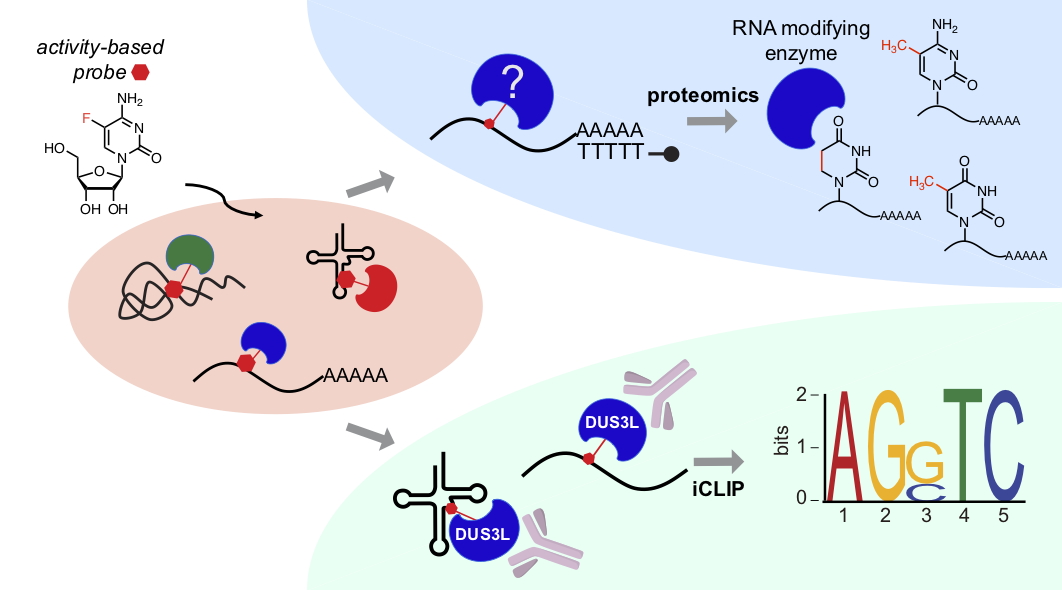
We have developed a reactivity-based approach for studying RNA modifying enzymes (‘writers’) that we have named RNA-mediated activity-based protein profiling (RNABPP). Our strategy relies upon metabolic labeling of cellular RNA with mechanism-based nucleoside warheads combined with RNA-protein enrichment and quantitative mass spectrometry-based proteomics. We used RNABPP with 5-fluoropyrimidines to discover and profile the substrates of a human dihydrouridine synthase (DUS) enzyme. We are now expanding this approach to reveal new classes of RNA modifying enzymes in diverse biological contexts.
Relevant publications:
Activity-based RNA-modifying enzyme probing reveals DUS3L-mediated dihydrouridylation. Dai, W.; Li, A.; Yu, N.J.; Nguyen, T.; Leach, R.W.; Wuhr, M.; Kleiner, R.E. Nat. Chem. Biol. (2021), 17:1178-1187. web
Reactivity-dependent profiling of RNA 5-methylcytidine dioxygenases. Arguello, A.E.; Li, A.; Sun, X.; Eggert, T.W.; Mairhofer, E.; Kleiner, R.E. Nat. Commun. (2022), 13:4176. web
Cell type-specific translational regulation by human DUS enzymes. Yu, N.J.; Dai, W.; Li, A.; He, M.; Kleiner, R.E. bioRxiv (2023) web
Sequence- and structure-specific tRNA dihydrouridylation by hDUS2. Ji, J.; Yu, N.J.; Kleiner, R.E. ACS Cent. Sci. (2024) ASAP web
Chemoproteomic profiling of RNA modification ‘reader’ proteins
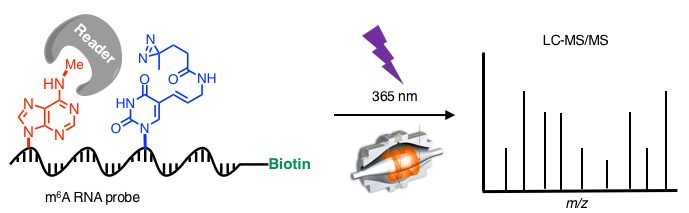
We are interested in understanding the biochemical mechanisms underlying the function of epitranscriptomic RNA modifications. Towards this end, we have developed a chemical proteomics approach relying upon photocrosslinking and quantitative mass spectrometry-based proteomics to characterize RNA-protein interactions regulated by RNA modifications. We have applied our approach to characterize the protein interactome of N6-methyladenosine (m6A), the most abundant internal modification on eukaryotic mRNA, as well as N1-methyladenosine (m1A) and other mRNA modifications. We are now pursuing the biological functions of newly discovered modification-specific protein-RNA interactions and expanding our approach to study newly characterized mRNA modifications.
Relevant publications:
RNA Chemical Proteomics Reveals the N6-Methyladenosine (m6A)-Regulated Protein-RNA Interactome. Arguello, A. E.; DeLiberto, A. N.; Kleiner, R. E. J. Am. Chem. Soc. (2017), 139:17249–17252. web
YTHDF2 recognition of N1-methyladenosine (m1A)-modified RNA is associated with transcript destabilization. Seo K.W.; Kleiner, R.E. ACS Chem. Biol. (2020), 15:132-139. web
A neural m6A/Ythdf pathway is required for learning and memory in Drosophila. Kan, L.; Ott, S.; Joseph, B.; Park, E.S.; Dai, W.; Kleiner, R.E.; Claridge-Chang, A.; Lai, E.C. Nat. Commun. (2021), 12:1458. web
Chemoproteomic profiling of 8-oxoguanosine-sensitive RNA-protein interactions. Villers, J.; McCann Smith, E.; DeLiberto, A.N.; Arguello, A.E.; Nyaanga, J.; Kleiner, R.E. Biochemistry (2023), 62: 3411-3419. web
Nucleoside probes for studying cellular RNA metabolism, localization, and structure
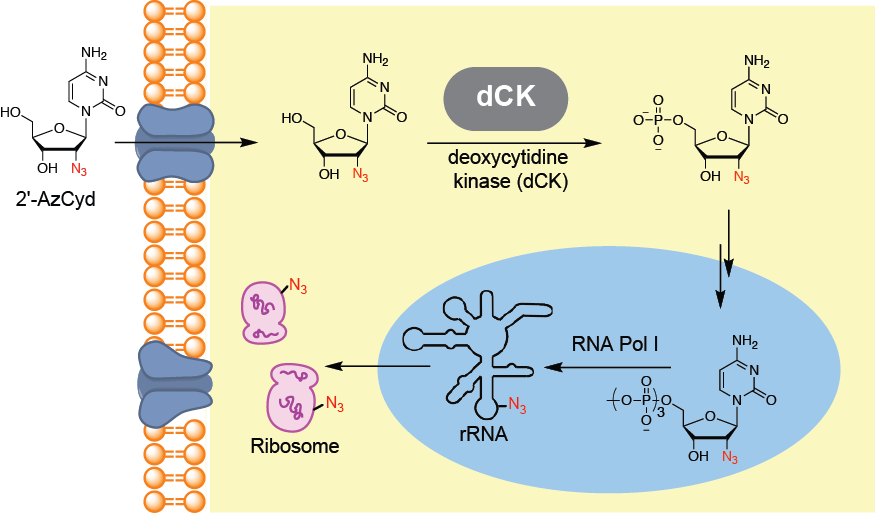
We have developed synthetic nucleoside probes for metabolic labeling of cellular RNA that can be applied to study RNA turnover, trafficking, and structure. By applying protein engineering to enzymes in the nucleotide salvage pathway, we have expanded the scope of modified nucleotide structures that can be incorporated into cellular RNA, including fluorescent nucleosides for imaging and bioorthogonal nucleosides for monitoring synthesis and turnover.
Relevant publications:
A Metabolic Engineering Approach to Incorporate Modified Pyrimidine Nucleosides into Cellular RNA. Zhang, Y.; Kleiner, R.E. J. Am. Chem. Soc. (2019), 141:3347-3351. web
Cell- and Polymerase-Selective Metabolic Labeling of Cellular RNA with 2′-Azidocytidine. Wang, D.; Zhang, Y.; Kleiner, R.E. J. Am. Chem. Soc. (2020), 142:14417-14421. web
Live-cell RNA imaging with metabolically incorporated fluorescent nucleosides. Wang, D.; Shalamberidze, A.; Arguello, A.E.; Purse, B. Kleiner, R.E. J. Am. Chem. Soc. (2022), 144: 14647-14656. web
Transcriptome-wide RNA structure probing with temporal resolution. Wang, D.; Tang, Y.; Li, A.; Sun, L.; Kleiner, R.E. bioRxiv (2023) web
RNA-protein granules
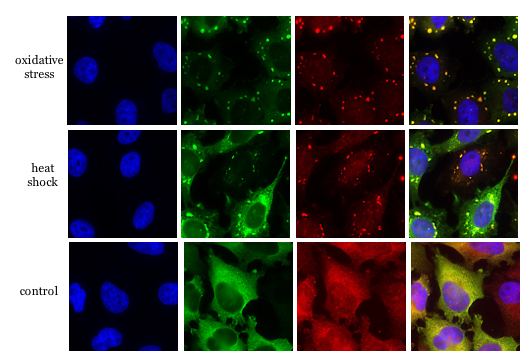
We are interested in the biological functions of RNA-protein granules and the mechanisms underlying their assembly. RNA-protein granules (e.g. stress granules, P-bodies, nucleoli) are proposed to form by liquid-liquid phase separation (LLPS) and are implicated in a number of biological processes. A major outstanding question is the effect of RNA accumulation in these structures on RNA metabolism, translation, etc. We are developing new approaches to characterize the incorporation of RNA transcripts into RNA-protein granules, with a particular emphasis on understanding how epitranscriptomic RNA modifications regulate the accumulation of transcripts in stress granules.
Relevant publications:
Profiling dynamic RNA-protein interactions using small molecule-induced RNA editing. Seo, K.W.; Kleiner, R.E. Nat. Chem. Biol. (2023), 19: 1361-1371. web
Global Discovery of Covalent Modulators of Ribonucleoprotein Granules. Ciancone, A.M.*; Seo, K.W.*; Chen, M.*; Borne, A.L.; Libby, A.H.; Bai, D.L.; Kleiner, R.E.*; Hsu*, K.L. J. Am. Chem. Soc. (2023), 145:11056-11066. web